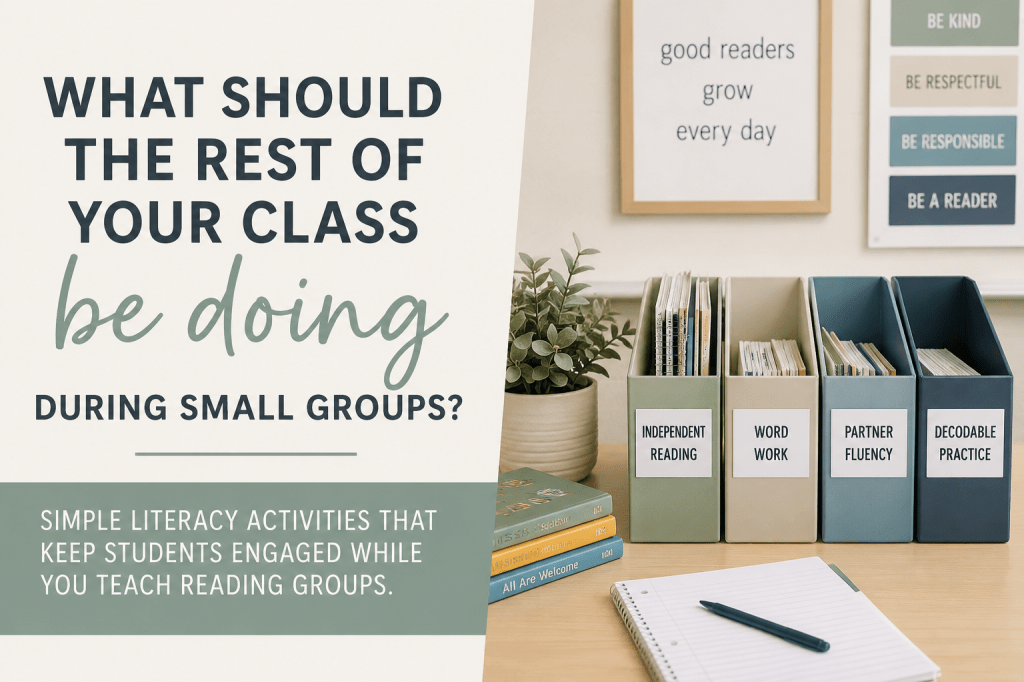
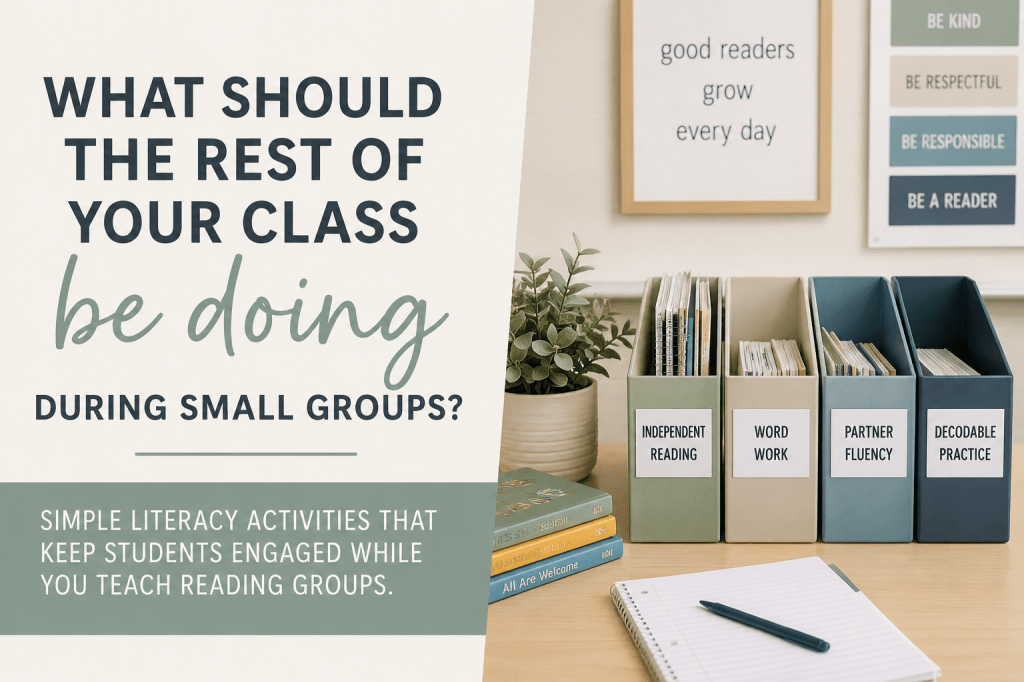
What Should the Rest of Your Class Be Doing During Small Groups?
Simple literacy activities that keep students engaged while you teach reading groups.
I remember my first few years of teaching small groups.
I’d finally get my reading group settled, open up my lesson materials, and within thirty seconds someone would need to sharpen a pencil.
A minute later, another student would be standing next to my table asking where to put their paper.
Then someone else would announce that their partner wasn’t sharing.
Before I knew it, I had spent more time managing interruptions than actually teaching.
If you’ve ever wondered, “What should the rest of my class be doing while I’m teaching small groups?” you’re definitely not alone.
In fact, it’s one of the questions teachers ask me most often.
After eighteen years in the classroom, I’ve learned that successful small groups have less to do with what happens at the teacher table and more to do with what everyone else is doing.
The goal isn’t to keep students busy.
The goal is to keep them meaningfully engaged in literacy activities they can do independently.
Here’s what worked best in my classroom.
Independent Reading: My Non-Negotiable
If you walked into my classroom during reading time, you’d almost always see students reading.
Independent reading became the foundation of everything else we did.
Students had book boxes filled with books they could successfully read, and they knew exactly what was expected of them.
Did it happen perfectly on the first day of school?
Absolutely not.
Teaching independent reading takes time.
But once students learn how to choose books, stay in one spot, and solve small problems on their own, it becomes one of the most valuable parts of your literacy block.
And honestly, there’s something really special about looking up from your small group table and seeing an entire room of children engaged with books.
Word Work: Meaningful Practice Without Constant Teacher Help
One mistake I made early in my teaching career was creating centers that were too complicated.
Students constantly needed help.
That defeated the whole purpose.
Eventually I realized that simple was better.
Much better.
Word work became one of my favorite rotations because students could practice phonics skills independently while reinforcing what we had already learned together.
Some days students sorted words.
Some days they built words.
Other days they completed a simple phonics page or worked with letter tiles.
The activity itself wasn’t what mattered most.
The consistency was.
When students know exactly what to do, they become much more independent.
And independence is the secret ingredient to successful small groups.
Partner Fluency: The Rotation Students Always Loved
If I asked my students which rotation was their favorite, partner fluency usually won.
There’s something magical about giving children a chance to read with someone else.
They practiced expression.
They built confidence.
They improved their accuracy.
Most importantly, they were reading.
A lot.
Sometimes students completed repeated readings.
Sometimes they practiced fluency passages.
Sometimes they simply took turns reading familiar texts.
Nothing fancy.
Just lots of opportunities to practice.
As teachers, we often focus so much on comprehension and phonics that fluency can accidentally become an afterthought.
But fluency practice was one of the easiest ways to keep students engaged while strengthening their reading skills.
Decodable Practice: Extending What We Taught
When we learned a new phonics pattern, I wanted students to continue practicing it beyond our small group lessons.
That’s where decodable readers became incredibly valuable.
Students would reread decodable books independently or with a partner.
The books were familiar.
The phonics patterns were familiar.
And because the text was controlled, students could experience success.
I loved seeing students apply the exact skills we had practiced together.
Instead of guessing at words, they were using the phonics patterns they had learned.
That’s where real confidence starts to grow.
My Reading Rotation Setup
Over the years, I tried plenty of complicated center systems.
Color-coded charts.
Pocket charts.
Task cards.
Rotating bins.
Honestly?
Most of them created more work for me than they were worth.
Eventually I settled on a simple rotation structure and a PowerPoint presentation:
Independent Reading
Word Work
Partner Fluency
Decodable Practice
Teacher time
That’s it.
No elaborate setup.
No hours of weekly prep.
No constantly changing activities.
Just meaningful literacy work students could do independently while I focused on teaching.
And that’s really what we want, isn’t it?
To spend our small group time actually teaching instead of managing.
The Biggest Lesson I Learned
If there’s one thing I wish someone had told me years ago, it’s this:
Students don’t need new activities every week.
They need predictable routines.
When students know exactly what to do, they ask fewer questions.
When they ask fewer questions, they interrupt less.
When they interrupt less, your small groups become more effective.
Simple systems create calm classrooms.
And calm classrooms create better readers.
Looking for Ready-to-Go Activities?
Many of the Word Work and Fluency activities I created for my own classroom eventually became the resources I now share with other teachers.
If you’re looking for simple, effective literacy activities that students can complete independently during small groups, be sure to check out all of my Small Group resources here.
They’re designed to help students stay engaged while giving teachers one less thing to plan.
Because small groups are challenging enough without having to reinvent your literacy centers every week.

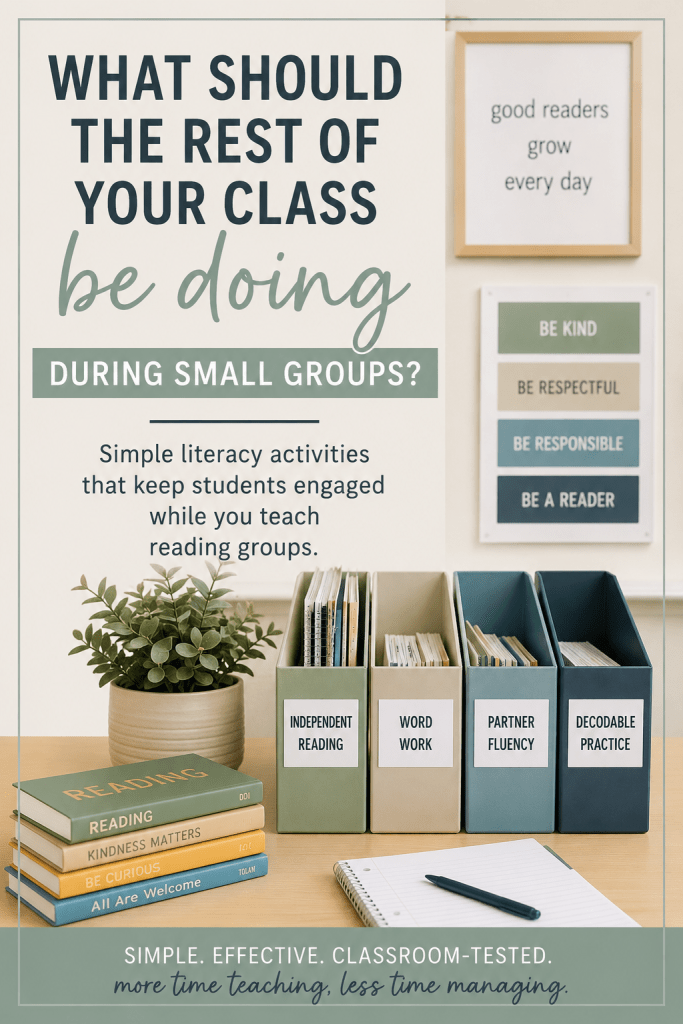
These are the same types of activities I use in my own classroom to keep students engaged while I teach small groups. If you’re looking for ready-to-go resources, you’ll find my Small Groups Made Easy resources that are designed to fit seamlessly into this system.
About the Author
Hi, I’m Leslie. I’m a first-grade teacher with 18 years of classroom experience and the creator of Small Groups Made Easy. I help K–2 teachers simplify literacy instruction with practical, classroom-tested resources that save time and build confident readers.



Leave a comment