If you’ve ever sat down to plan your reading groups and thought, There has to be an easier way than this, you’re not alone.
For years, I believed every small group lesson needed to be completely different. I spent hours gathering materials, planning activities, and trying to make every group feel special. Some days I had a great lesson. Other days I felt like I was piecing things together at the last minute and hoping for the best.
Eventually, I realized something important:
My students didn’t need a new routine every day.
They needed consistency.
Once I created a simple structure for my small groups, everything changed. Planning became easier. Students knew exactly what to expect. Behavior improved. Most importantly, my students made stronger reading gains because we spent more time practicing and less time transitioning between activities.
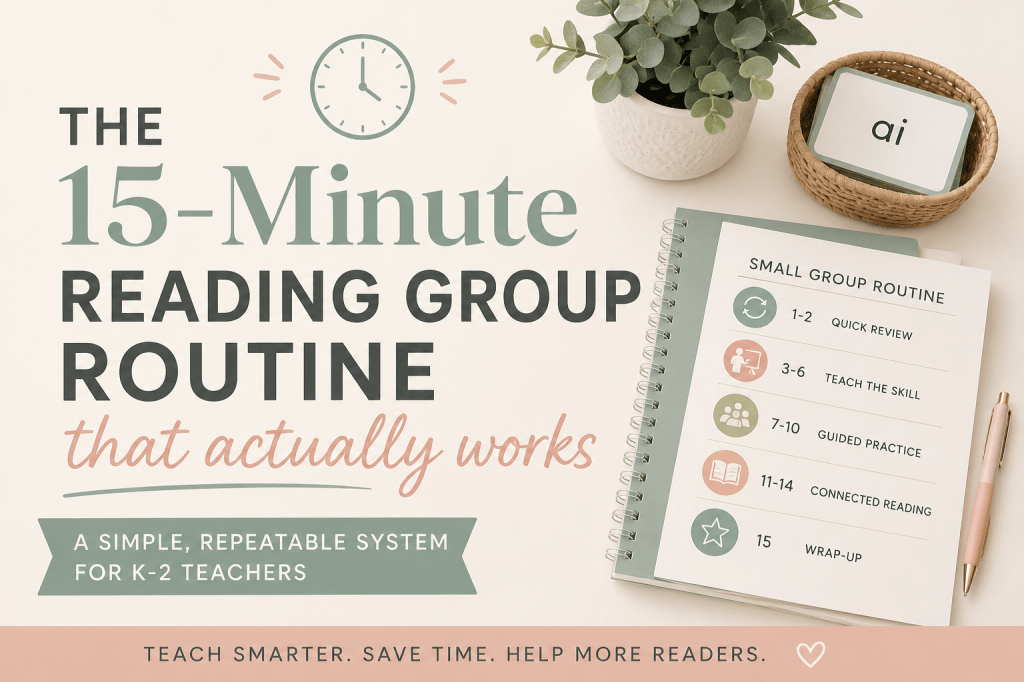
Today, I want to share the simple 15-minute reading group routine that has worked in my classroom year after year.
Why I Switched to 15-Minute Reading Groups
When I first started teaching, I thought longer lessons meant better instruction.
Now I know that’s not necessarily true.
Young readers thrive when instruction is focused, explicit, and predictable. Fifteen minutes is often the perfect amount of time to review a skill, teach something new, practice it together, and apply it in real reading.
A shorter routine also allows you to meet with more groups throughout the week without spending your entire day at the small group table.
The goal isn’t to cram as much as possible into each lesson.
The goal is to consistently move students forward.
My Simple 15-Minute Reading Group Routine
This routine works with phonics groups, intervention groups, and most K-2 reading groups.
Minutes 1-2: Quick Review
Every group starts with a review.
This might include:
- Reviewing sound cards
- Reading previously learned words
- Practicing sight words
- Quick blending drills
- Oral phonemic awareness practice
Starting with success helps students feel confident and ready to learn.
It also gives you a chance to quickly identify if students need additional support with a previously taught skill.
Minutes 3-6: Teach the Target Skill
This is the only part of the lesson where I introduce something new.
The key is to keep it brief and explicit.
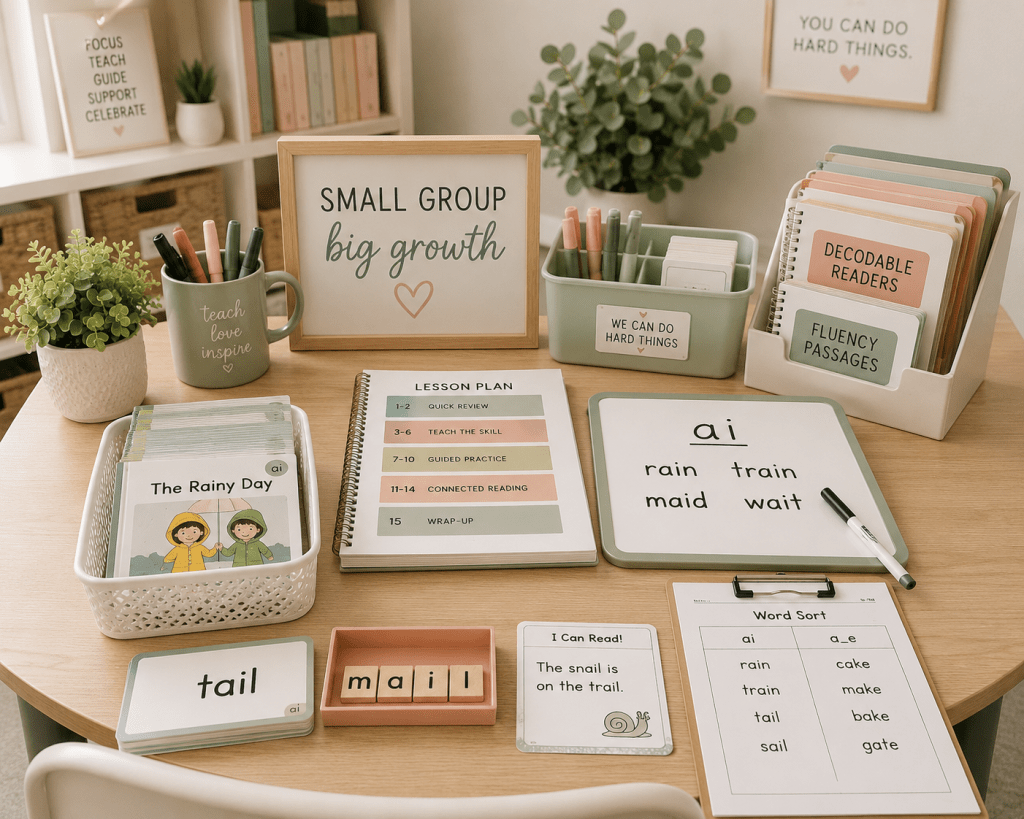
For example, if I’m teaching the long a vowel team “ai,” I might:
- Introduce the pattern
- Model reading several words
- Explain when the spelling is commonly used
- Think aloud while decoding
I try very hard not to turn this into a lengthy mini lesson.
Young readers learn best when instruction is clear and then quickly followed by practice.
Minutes 7-10: Guided Practice
This is where students begin applying the new skill with support.
Depending on the lesson, we might:
- Read words together
- Sort words
- Build words with letter tiles
- Practice decoding sentences
- Complete a quick word work activity
This is often where the most valuable teaching happens.
As students practice, I can immediately correct errors, answer questions, and provide feedback.
Minutes 11-14: Connected Reading
This is my favorite part of the lesson.
Students use the skill in actual reading.
We might read:
- A decodable reader
- A fluency passage
- A short phonics-based text
- Targeted intervention text
This is where students begin connecting isolated phonics skills to real reading.
It’s one thing to read a list of words.
It’s another thing entirely to apply those skills in connected text.
Minute 15: Quick Wrap-Up
Before students leave, we take one minute to review.
I might ask:
- What skill did we practice today?
- Can you read one final word?
- Can you tell me when we use this spelling pattern?
Then I celebrate their effort and send them on their way.
This quick closure helps reinforce learning and provides a natural ending to the lesson.

What Is the Rest of the Class Doing?
This is usually the first question teachers ask.
While I’m meeting with small groups, the rest of my students are working independently on meaningful literacy tasks.
Some of my favorite options include:
- Independent reading
- Word work activities
- Partner fluency practice
- Decodable reading
- Simple literacy centers
- Phonics review activities
The goal is to keep these activities familiar and manageable so students can work successfully without constant teacher support.
The simpler the rotations, the smoother your small groups will run. To read more about how I manage my groups with a PowerPoint presentation, check out this post.
Why This Routine Works So Well
After years of teaching, I’ve found that this routine works because it removes unnecessary complexity.
Students know what to expect.
Transitions are faster.
Planning takes less time.
Instruction stays focused.
Most importantly, students get repeated opportunities to practice essential reading skills.
I don’t spend my evenings searching for a new activity every day.
I simply follow the same structure and swap in the skill we’re working on.
The routine stays the same, just the learning skill changes, and that’s what makes it sustainable.
You Don’t Need More Activities. You Need a System.
One of the biggest mistakes I see teachers make is searching for more activities when what they really need is a simple system.
The truth is that effective small groups aren’t built on hundreds of random activities.
They’re built on a consistent routine, strong instructional materials, and intentional practice.
When those pieces are in place, planning becomes dramatically easier.
Ready to Simplify Your Reading Groups?
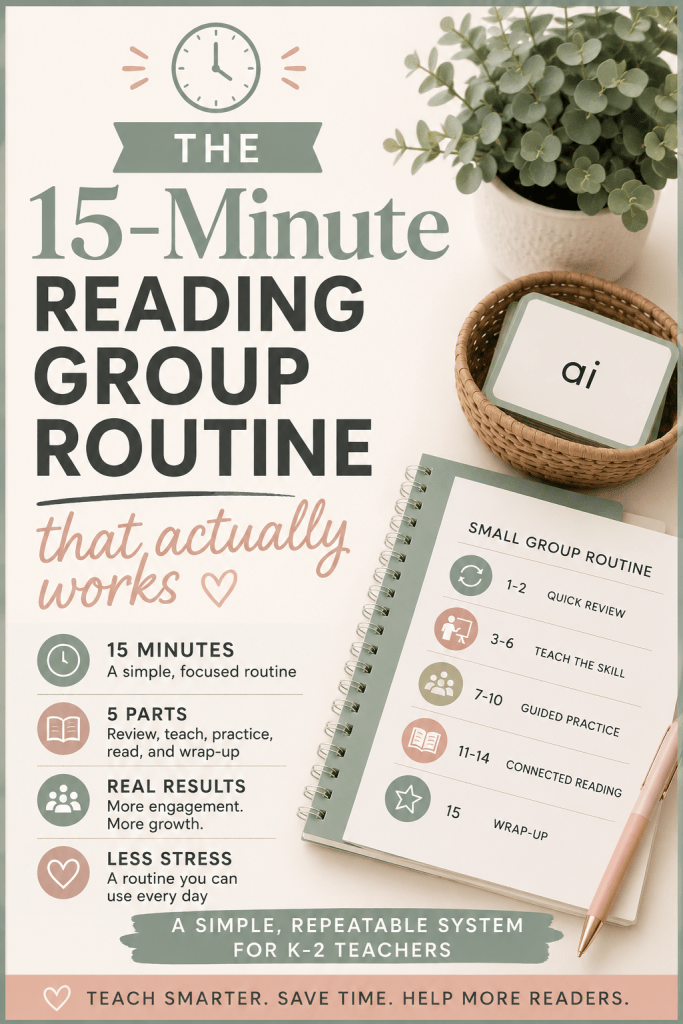
If you’re tired of piecing together small group lessons every week, the Small Groups Made Easy System was created for you.
Inside the system, you’ll find everything you need to run effective reading groups without spending hours planning:
- Decodable readers
- Fluency lessons
- Word work activities
- Phonics crafts
- Organized lessons by skill
- Science of Reading aligned resources
Instead of starting from scratch every week, you’ll have a complete system that helps you confidently teach small groups all year long.
Because your evenings should be spent with your family—not planning tomorrow’s reading lesson.
 Small Groups Made Easy
Leave a comment